We watched “The Fifth Element” the other night, largely because it happened to be on TV, and none of those assembled seemed to be able to muster the strength to change the channel. A reasonably entertaining film, a tad on the cheesy side, but likeable enough. I remember, though, how thoroughly disappointed I was the first time I saw it. This was some time ago, when I was only mostly bitter and jaded, and, noting that it had been an awfully long time since anyone had attempted anything remotely like a serious science fiction film, I harbored a secret hope that, someday soon, somebody in Hollywood would awaken to the near limitless possibilities opened up by the explosion in computer-aided special effects, and would put all that expensive expertise to some truly imaginative use. Alas, Bruce Willis and Luc Besson were not that someone, even if the film DID have the odd glorious outburst of inspired production design.
The problem was one of expectation. The opening minutes seemed to promise something …bigger. Before the story settled into standard stoic- hero- battling- set-chewing- villain, Bruce-Willis-shooting-up-a- cruise-ship territory. I thought, for a few minutes, that I was going to see something epic, original, perhaps even intelligent, perhaps moving…exploring big questions the way sometimes only truly good fantasy can. I thought I was going to see something I’d never seen before, be sucked into a new and intricate world for two hours, one that I would reluctantly drift out of as I wandered back onto the street, forgetting, for a while, the mundane land we actually inhabit.
It was that film, that imagined film, that I wanted to see. That sweeping drama hinted at by the prologue and the rapid jumble of exotic images that constitute the trailer. Built of unknowns, mysteries awaiting discovery, possibilities…the undefined, the stuff around the edges, just eluding a clear grasp.
Likely, no film Luc Besson could ever complete, in a final, fully exposed form, could hold a candle to it.
Italo Calvino wrote If On a Winters Night A Traveller, about, sort of, a man who reads the first chapter of a novel, and keeps searching for the remainder of the book, only to continuously find different first chapters to different novels. A whole book of beginnings with no endings, all promise with no letdown, (but no satisfying resolution, either) opening limitless imagined stories to the reader, but locking none of them into place.
A good beginning is hard, but not as hard as bringing a good beginning all the way through to a good ending. Beginnings are exciting, because they are new, they introduce new things without necessarily having to explain them, put them in context, or flesh them out. They can be full of mystery, leaving one wondering what’s coming. And what I imagine is coming, in all its tantalizing vagueness, is usually far cooler than what actually plays out.
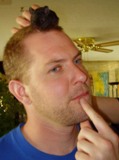
 This me at the cafe, which is starting to feel a bit like a second home, lately. Not sure why, really. I'm not working there that much. Its more central, i guess, and maybe i like being closer to where the action is. Those who've been following current events, er, don't read too much into that. That wasn't what i meant.
Wash: "Everything looks good from here... Yes. Yes, this is a fertile land, and we will thrive."
"We will rule over all this land, and we will call it... 'This Land'."

"I think we should call it...your grave!"

"Ah, curse your sudden but inevitable betrayal!"
"Ha ha HA! Mine is an evil laugh...now die!"

Shema
You who live secure
In your warm houses,
Who return at evening to find
Hot food and friendly faces:
Consider whether this is a man,
Who labours in the mud
Who knows no peace
Who fights for a crust of bread
Who dies at a yes or a no.
Consider whether this is a woman,
Without hair or name
With no more strength to remember
Eyes empty and womb cold
As a frog in winter.
Consider that this has been:
I commend these words to you.
Engrave them on your hearts
When you are in your house, when you walk on your way,
When you go to bed, when you rise.
Repeat them to your children
Or may your house crumble,
Disease render you powerless,
Your offspring avert their faces from you.
Primo Levi (trans. Ruth Feldmann)
I am an observer and a recorder, perhaps, a subtle commentator, on experience. I am not a rigorous analyst. I not one for shoe-horning the mystery of reality into categories, into an all embracing schema for the world, even if that schema is one that claims to deny that is what it is doing. What is, IS and I question whether our efforts to master it, to lay down what and how it is, and what it isn’t are not doomed from the start. I am an impressionist- into senses, not exact structures. Feelings over rigorous explanations and attempts at exact description. I know the world as what I sense it to be. My sense of how it SHOULD be. That sense carries more weight to me than any detailed, intricately worked out analysis.
This is my approach to art. I paint on instinct, a feeling for what looks and feels right, what “works” and what doesn’t. Some intelligence underlies that, to be sure. Knowledge I have absorbed intellectually about design, composition, contrast, and colour. But if I think too much about those things while painting, my art suffers. Such information works best in the background, feeding itself unconsciously into my aesthetic sense.
This is also, naturally, how I prefer to approach others' art. I want to experience it, let it wash over me, and draw my impressions from that, not from rigorous examination of technique or of the ideas supposedly represented. I am interested in what art, literature, architecture, or film, even religion, makes me feel.
This is why the approach school makes me take to, say, Shakespeare, feels like violence.
Forcing one’s will upon it, invading it and plundering it in search of “what it means” or “what I can get out of it”. Literature, art, as yet another commodity, another resource to exploited and “developed” by man until whatever beauty it once possessed is obscured by viewing platforms, casinos and tourist hotels, mining operations and oil rigs.
Is such a reservation just an idealistic excuse for intellectual laziness?
I don’t know. But the activity of school as I am experiencing it feels increasingly invasive and unnatural. I have increasing difficulty imagining making a life of it.
Awake
The ridiculous morning rooster cries
Arise and join your world
The sun is up
Red and Fiery
Casting sharp light on the land
And, suddenly
Nothing is hidden
In your plush
Flower-papered bedroom
You are warm
Beneath soft, pleasant sheets
And comfortable
Your head sunk nicely
In enveloping pillow
I will rest yet, you say
My dreams are pleasant
I am not yet ready to face
The day
My dreams are grand, and noble
Mighty adventures
And oh so safe
Being only dreams
Awake!
The rude bird screams again
Leave your petty dreams
Let your eyelids struggle open
To the magnificent blaze
Of morning
Streaming through your painted windows
Awake I say again!
You have slept long
Your limbs are stiff
You had best check your house and fields
Lest
While you sleep on, in mighty dreams
The thief has come
Stolen all you once possessed
Taken your lambs away
While they had yet to see
This dawn.